


13 November 2025
Media & PressFrom Made in Italy to Vietnam: Atlante explores the new frontier of Italian wine
From emerging market to strategic destination: Vietnam is undergoing a rapid transformation in its wine landscape, driven by a growing middle class, the expansion of restaurants, wine bars and international hospitality, and an increasing curiosity for Western lifestyles.
In this context, Made in Italy wine is gaining visibility alongside global competitors, but success requires building strong positioning, product education, and solid relationships with local trade partners.
In an interview with Il Sole 24 Ore, Atlante CEO Natasha Linhart discusses the figures, trends and challenges shaping this evolving market, highlighting Vietnam’s potential for Italian wine. From this perspective, Atlante sees the country as a particularly promising opportunity: through the distribution of a curated selection of wines by Alessandro Berselli (Vini d’Italia), the company offers importers and consumers a portfolio that brings together different territories, grape varieties and styles—while maintaining the excellence and authenticity of Italy’s winemaking tradition.
Vietnam: a new frontier for Made in Italy wine
Insights from Natasha Linhart in Il Sole 24
by Michela Cappellini Il Sole 24 ore, 13 november 2025 | Online Article
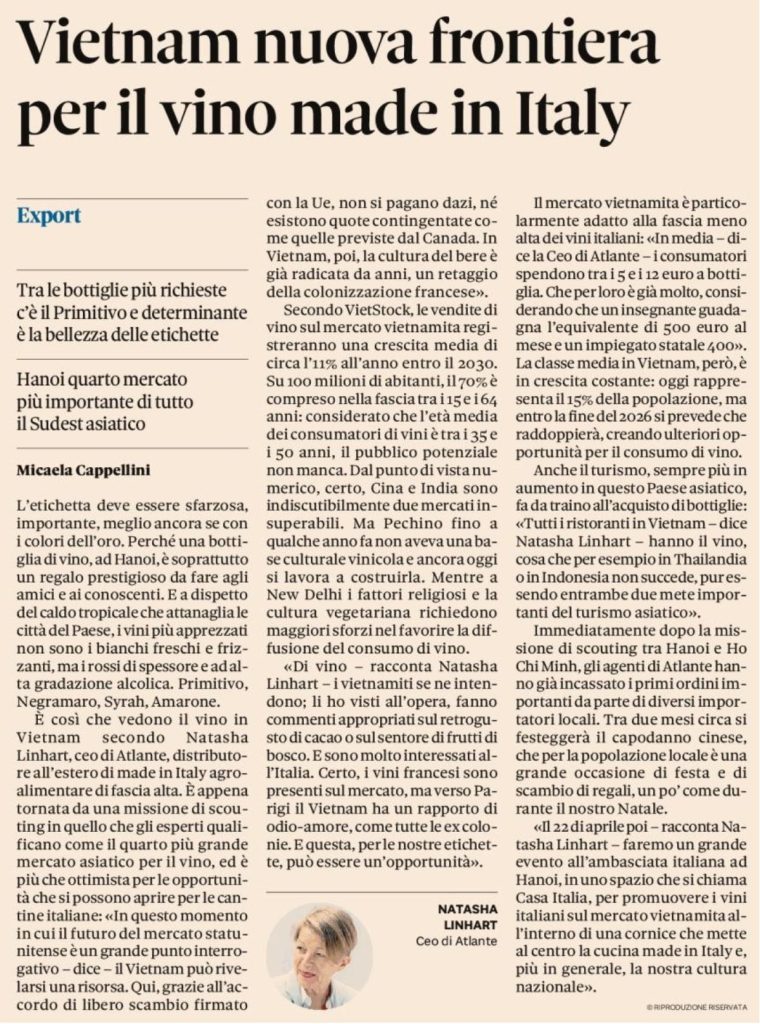 appreciated by local consumers are largely reds: full-bodied, intense and richly spiced. Primitivo is the top choice, but Aglianico and Syrah are also well received, as is Nero d’Avola, and demand continues to rise.
“In the past two years, the market has grown by 60%,” says Natasha Linhart, CEO of Atlante, an Italian distributor of Made in Italy wines. “And growth is set to continue: in the first half of 2024 we were approaching +25%. For comparison, Canada is growing at around 15%. In Vietnam, the opportunities are enormous.”
Italian wine is highly appreciated—just as Made in Italy is more broadly. “And there are no duties,” Linhart adds. “Vietnam is one of the Asian countries with the most extensive free-trade agreement with the EU. No duties, no quotas like those in place in Canada. And the country already has a long-standing wine culture, a legacy of French colonial influence.”
According to VitisCC, wine sales in Vietnam are expected to grow by an average of 11% per year until 2030. Today, the average retail price per bottle ranges from €7.5 to €15.
Local consumers fall mainly within the 15–65 age bracket and have adequate purchasing power. While China and India remain the primary export destinations for Italian wine in Asia, Hanoi ranks fourth in overall market impact.
Vietnamese consumers are rapidly evolving in their tastes, increasingly seeking quality products. Interest in premium wines is growing, especially in major urban centres such as Hanoi and Ho Chi Minh City, while lower-priced categories face strong competition from Chile, Argentina and South Africa.
The Vietnamese market is particularly suited to mid-range and upper-mid-range wines. “On average,” Linhart explains, “consumers spend between €15 and €21 per bottle, and in major cities this can easily rise to €50.”
Market growth, the breadth of opportunities for Italian wine, and the low level of commercial barriers all support increased imports and strengthen the positioning of Italian producers.
“Our wines,” Linhart notes, “benefit from the reputation of Italy as a country. Italian products are perceived as reliable, high-quality, safe and sustainable.”
Data confirms the trend: while brandy and whisky remain the most imported alcoholic spirits in Vietnam, wine consumption is growing steadily.
Italian wine resonates strongly with consumers—but not all categories. “Structured reds are particularly appreciated,” Linhart says. “White wines less so, although Prosecco remains stable and well positioned. The market is evolving, but still being built—something that can favour Italian companies if they adapt to local needs.”
Vietnamese consumers are also highly attentive to presentation. “Labels make a big difference,” concludes Linhart. “They want refined design, impactful bottles—and, beyond the product itself, the cultural value and identity that Italy brings.”