


7 January 2026
Media & PressBuilding Systems for Global Markets: Natasha Linhart on the Future of Italian Food
2026 will be a year defined by strategic awareness and the imperative to build cohesive business systems. This is the perspective shared by Natasha Linhart, CEO of Atlante, in an interview published by Italia Oggi on December 24.
In a global landscape where traditional markets, such as the United States, face uncertainties driven by tariffs and shifting trade policies, Italy’s export strategy must evolve. Relying solely on the intrinsic quality of a product is no longer sufficient; success now requires business aggregation, the ability to adapt to local cultures, and significant investment in technology.
From the Asian “new frontier” to the challenges of the green transition, here is Atlante’s analysis of the dynamics that will shape the agri-food sector in the coming years.
The full interview is available below.
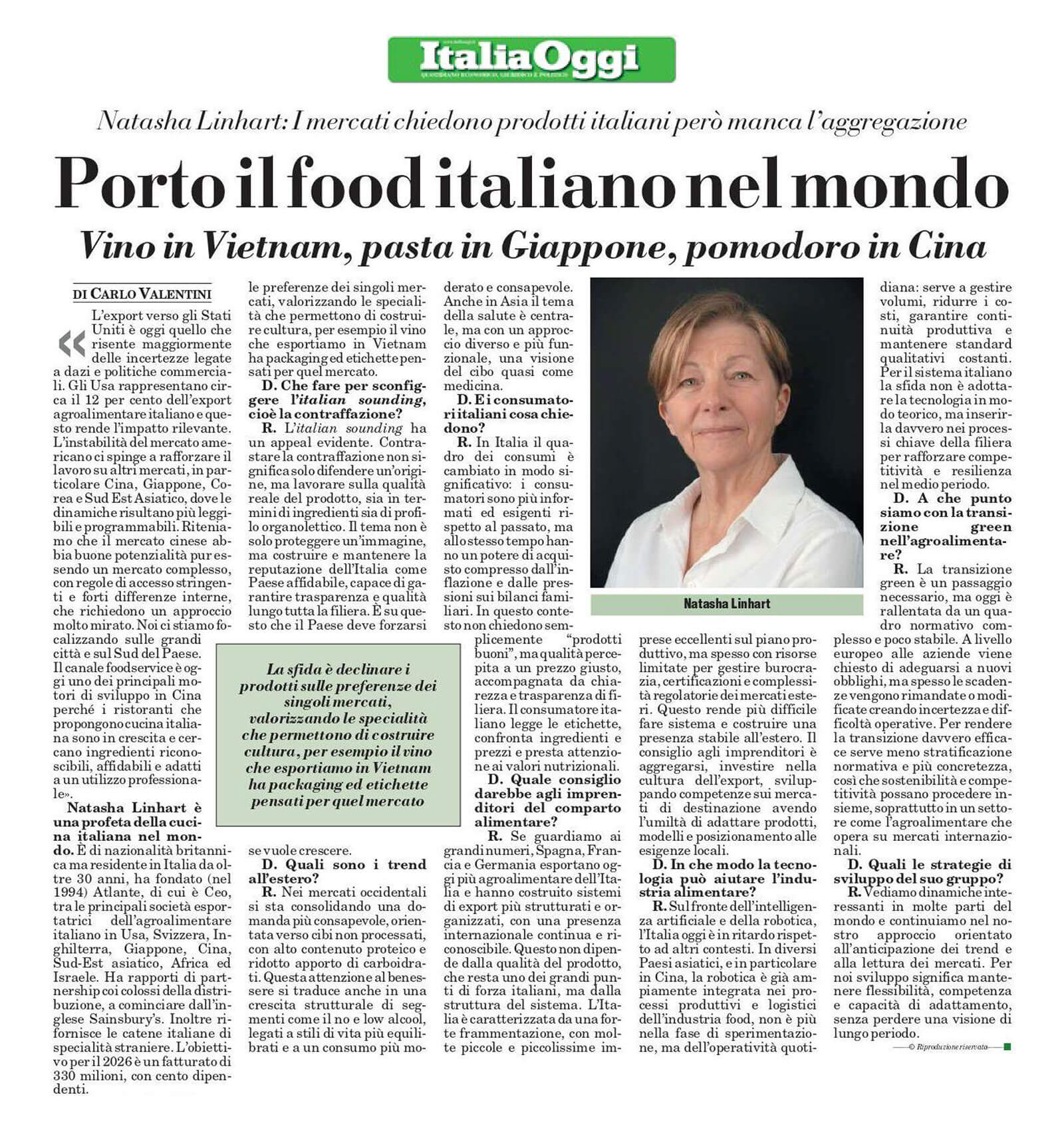
Porto il food italiano nel mondo
Bringing Italian Food to the World
Wine in Vietnam, Pasta in Japan, Tomatoes in China
By Carlo Valentini | Italia Oggi, 24/12/2025
Exports to the United States are currently the most affected by uncertainties surrounding tariffs and trade policies. The US accounts for approximately 12% of Italian agri-food exports, making the impact significant. The instability of the American market is driving us to strengthen our efforts in other regions, particularly China, Japan, Korea, and Southeast Asia, where market dynamics are more predictable and programmable. We believe the Chinese market holds great potential, despite being complex, with strict access regulations and strong internal differences that require a highly targeted approach. We are focusing on major cities and the southern part of the country. Today, the foodservice channel is one of the primary drivers of growth in China, as restaurants offering Italian cuisine are increasing and seeking recognizable, reliable ingredients suitable for professional use.
Natasha Linhart is an advocate for Italian cuisine worldwide. A British national who has lived in Italy for over 30 years, she founded Atlante in 1994. As CEO, she leads one of the top companies exporting Italian agri-food products to the US, Switzerland, the UK, Japan, China, Southeast Asia, Africa, and Israel. The company maintains strategic partnerships with retail giants, including the UK’s Sainsbury’s, and supplies Italian chains with international specialties. The target for 2026 is a turnover of 330 million euros, with a workforce of one hundred employees.
Q. What is the current health of the Italian agri-food industry?
A. In recent years, it has made significant strides, especially regarding quality and brand recognition. However, the “last mile” in international markets remains the capacity for adaptation. We often take for granted that the value of a product’s “Italianness” is immediately perceived abroad, but this isn’t always the case. In Japan, for instance, Italian pasta is not necessarily distinguished from other origins, and we struggle to make it stand out. In China, Italian tomatoes do not enjoy an automatic competitive advantage over local products. The challenge lies in tailoring products to the preferences of individual markets and emphasizing specialties that build food culture. For example, the wine we export to Vietnam features packaging and labels specifically designed for that market.
Q. How can we combat “Italian Sounding” and counterfeiting?
A. Italian Sounding has an obvious appeal. Counteracting counterfeiting isn’t just about defending an origin; it’s about working on the real quality of the product, both in terms of ingredients and organoleptic profile. The issue isn’t just protecting an image, but building and maintaining Italy’s reputation as a reliable partner capable of guaranteeing transparency and quality throughout the entire supply chain. This is where the country must focus its efforts if it wants to grow.
Q. What are the key trends abroad?
A. In Western markets, we see a consolidating demand for more conscious choices, oriented toward unprocessed foods, high protein content, and reduced carbohydrates. This focus on well-being also translates into structural growth for segments like “no and low alcohol,” linked to balanced lifestyles and more moderate consumption. In Asia, health is also a central theme, but with a different, more functional approach—viewing food almost as medicine.
Q. And what are Italian consumers asking for?
A. In Italy, consumption patterns have changed significantly. Consumers are better informed and more demanding than in the past, yet their purchasing power is squeezed by inflation and household budget pressures. In this context, they don’t just ask for “good products,” but for perceived quality at a fair price, accompanied by supply chain clarity and transparency. Italian consumers read labels, compare ingredients and prices, and pay close attention to nutritional values.
Q. What advice would you give to entrepreneurs in the food sector?
A. If we look at the numbers, Spain, France, and Germany currently export more agri-food products than Italy and have built more structured and organized export systems with a continuous, recognizable international presence. This doesn’t depend on product quality—which remains one of Italy’s great strengths—but on the system’s structure. Italy is characterized by heavy fragmentation, with many small and micro-businesses that excel in production but often lack the resources to manage bureaucracy, certifications, and the regulatory complexities of foreign markets. This makes it harder to act as a unified system and build a stable presence abroad. My advice to entrepreneurs is to aggregate, invest in export culture, and develop expertise in destination markets while having the humility to adapt products, models, and positioning to local needs.
Q. How can technology help the food industry?
A. Regarding Artificial Intelligence and robotics, Italy is currently lagging behind other regions. In several Asian countries, particularly China, robotics is already widely integrated into production and logistics processes; it’s no longer in the experimental phase but part of daily operations. It is used to manage volumes, reduce costs, ensure production continuity, and maintain consistent quality standards. For the Italian system, the challenge isn’t just adopting technology theoretically, but truly embedding it into the key processes of the supply chain to strengthen competitiveness and resilience in the medium term.
Q. Where do we stand with the green transition in the agri-food sector?
A. The green transition is a necessary step, but it is currently slowed down by a complex and unstable regulatory framework. At the European level, companies are asked to comply with new obligations, but deadlines are often postponed or modified, creating uncertainty and operational difficulties. To make the transition truly effective, we need less regulatory layering and more practicality, so that sustainability and competitiveness can advance together, especially in a sector like agri-food that operates in international markets.
Q. What are your group’s development strategies?
A. We see interesting dynamics in many parts of the world and continue our approach oriented toward anticipating trends and reading market signals. For us, development means maintaining flexibility, expertise, and the ability to adapt without losing our long-term vision.