


20 August 2026
Food FraudFood Fraud: Focus on Spreads
Atlante’s Food Fraud Observatory focuses on the risks associated with products and categories. The goal? To raise awareness and help businesses operate with greater responsibility.
Framework
In general, the category shows growth at value (+6.1%), partially mitigated by the honey segment (-2.1%). In particular, it is the proposal in large jars (>400g) that records the most accentuated slowdown with a drop to a value of -5.2% respectively.
Turnover of around 1 billion euros in Italy in the sweet spreads market over the last year, with an increasing trend in value (+6.1%) and volume (+1.4%). Creams and fruit-based jams are the main segments, at 47.5% and 38.5% of the category value, respectively. Honey follows at 14%. In the driving segment of creams, products in jars stand out (43.4%), followed at a distance by those in glasses (3.1%). For fruit-based jams, the main sub-segment with value are the references in the jar (20.5%). Within NIQ areas, the market grows in value and volume. Area 1 comes first in terms of weight, value and volume (27.8% and 26.9% respectively), with a more limited development in terms of value and volume compared to areas 2 and 3 (although considerable: +5.6%), as well as volume (+1%). Areas 2 and 3 grow at values of 7.6% and 6.3%, while volume growth is higher than the other areas (3.3% and 1.2%). Area 4 grows in value and volume less than the others (+4.9% and +0.3% respectively). In large-scale distribution, 76.9% of volume are concentrated. Specifically hyper 22.8%, super 43.6% and self-service stores with the minority share of 10.5%. A positive growth trend can be observed for value sales in large-scale distribution (+6%), with volume sales recording a more modest increase (+1%). Growth in value in large-scale distribution is driven similarly by all areas, with a slight predominance of 3 (+7.8%), although it holds a share of 19.9%. As regards the most subdued growth by volume, in area 4 it remains almost stable (+0.4%). Discounters carry 23% of volumes, with growth in value (6%) and volume (+2.5%) higher than the category average. The average price per package on all channels is increasing (+3.6% total Italy), determined by the increase in cross-segment prices, particularly in creams (+4.6%).
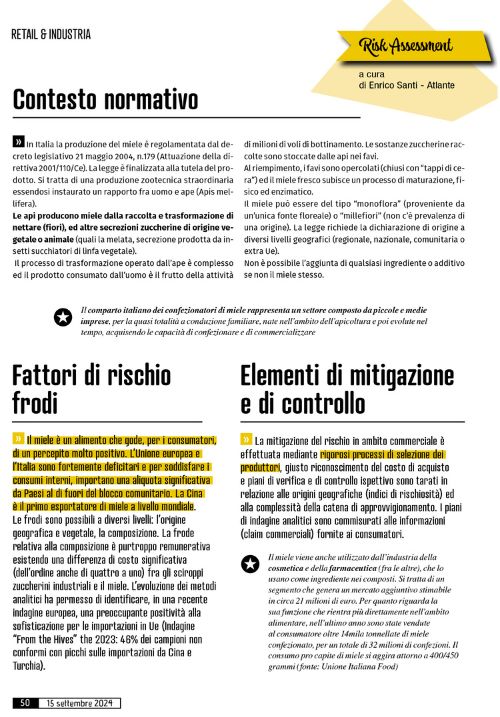
In Italy, honey production is regulated by Legislative Decree no. 179 of 21 May 2004 (Implementation of Directive 2001/110/EC). The law is aimed at product protection. This is an extraordinary livestock production as a relationship has been established between humans and bees (Apis mellifera). Bees produce honey from the collection and transformation of nectar (flowers), and other sugary secretions of plant or animal origin (such as honeydew, a secretion produced by insects that suck plant sap). The transformation process carried out by the bee is complex and the product consumed by humans is the result of the activity of millions of foraging flights. The collected sugary substances are stored by bees in honeycombs. When filled, the honeycombs are operculated (closed with “wax caps”) and the fresh honey undergoes a physical and enzymatic maturation process. Honey can be of the type “monoflora” (coming from a single floral source) or “millefiori” (there is no prevalence of an origin). The law requires the declaration of origin at different geographical levels (regional, national, EU or non-EU). The addition of any ingredient or additive other than honey itself is not possible.
The Italian honey packaging sector is a sector made up of small and medium-sized businesses, almost entirely family-run, founded in the beekeeping sector and then evolved over time, acquiring the skills to package and market.
Fraud risk factors
Honey is a food that enjoys a very positive perception for consumers. The European Union and Italy have a significant production deficit and they import a significant rate from countries outside the EU bloc to meet domestic consumption. China is the world’s leading honey exporter. Fraud is possible at several levels: geographical and plant origin, composition. The composition fraud is unfortunately profitable as there is a significant cost difference (of the order of four to one) between industrial sugar syrups and honey. The evolution of analytical methods has allowed us to identify, in a recent European survey, a worrying positivity in food adulteration for imports in the UE (Investigation “From the Hives” the 2023: 46% of non-compliant samples with peaks in imports from China and Turkey).
Mitigation and control factors
Commercial risk mitigation is achieved through rigorous producer selection processes, fair recognition of purchasing costs, and verification, and inspection plans are tailored to the geographic origins (risk indexes) and complexity of the supply chain. Analytical survey plans are commensurate with the information (commercial claims) provided to consumers.
Honey is also used by the cosmetics and pharmaceutical industries (among others), which use it as an ingredient in compounds. This is a segment that generates an additional market estimated at around 21 million euros. As for its function which falls more directly within the food sphere, over 14 thousand tonnes of packaged honey have been sold to the consumer in the last year, for a total of 32 million packages. Per capita honey consumption is around 400/450 grams (source: Italian Food Union).