


30 September 2026
Food FraudFood Fraud: Focus on Sandwiches
Atlante’s Food Fraud Observatory focuses on the risks associated with products and categories. The goal? To raise awareness and help businesses operate with greater responsibility.
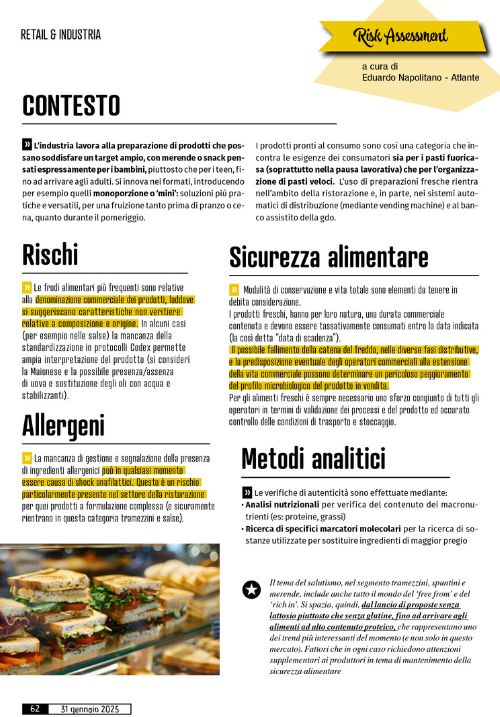
Framework
The industry is working to prepare products that can be healthy and satisfy a broad target audience, with snacks or snacks designed specifically for children, rather than teenagers, sand for adults. It innovates in formats, introducing for example single-serving or ‘mini’ ones: more practical and versatile solutions, for use both before lunch or dinner and during the afternoon. Ready-to-eat products are thus a category that meets consumer needs both for meals outside the home (especially during work breaks) and for organizing quick meals. The use of fresh preparations falls within the scope of catering and, in part, in automatic distribution systems (using vending machines) and at the assisted checkout counter in a supermarket.
Risks
The most frequent food frauds are related to the commercial designation of products, where untrue characteristics relating to composition and origin are suggested. In some cases (for example in sauces) the lack of standardization in Codex protocols allows for a broad interpretation of the product (consider Mayonnaise and the possible presence/absence of eggs and replacement of oils with water and stabilizers).
Food safety
Conservation methods and shelf life are elements to be taken into due consideration. Fresh products, by their nature, have a short commercial life and must be strictly consumed by the date indicated (the so-called “expiry date”). The possible failure of the cold chain, in the various distribution phases, and the potential predisposition of commercial operators to extend their commercial life can lead to a dangerous worsening of the microbiological profile of the product on sale. For fresh food, a joint effort by all operators is always necessary in terms of process and product validation and careful control of transport and storage conditions.
Allergens
Lack of management and reporting of the presence of allergenic ingredients can cause anaphylactic shock at any time. This is a particularly present risk in the catering industry for those products with complex formulations (and they certainly fall into this category sandwiches and sauces).
Analytical methods
Authenticity checks are carried out by:
- Nutritional analyses to verify macronutrient content (e.g. protein, fat)
- Search for specific molecular markers for the search for substances used to replace more valuable ingredients.
The health-consciousness trend, in the segment sandwiches, afternoon treats or snacks, also includes the whole world of ‘free from’ and ‘rich in’. They range, therefore, from the launch of lactose-free rather than gluten-free proposals, up to high-protein foods, which represent one of the most interesting trends of the moment (and not only in this market). Factors which in any case require additional attention from producers with regard to the maintenance of food safety.
Atlante contro le frodi alimentari: un impegno che parte dalla filiera
La frode alimentare è un rischio reale, sistemico e spesso sottovalutato. Per questo nel 2023 Atlante ha dato vita al programma di Food Fraud Risk Assessment — un percorso strutturato per identificare, analizzare e prevenire i rischi legati all’adulterazione e alla contraffazione lungo tutta la filiera, coordinato da Enrico Santi, Quality Assurance Manager.
Da questa competenza nasce la collaborazione con GDO Week: una rubrica curata dal team Qualità di Atlante, con approfondimenti su singole categorie merceologiche — dai fattori di rischio ai metodi di rilevamento, fino alle strategie di mitigazione.
Un contributo concreto al settore, rivolto alle catene della distribuzione, ai buyer e a tutti i partner che condividono la stessa responsabilità: garantire che ciò che arriva sullo scaffale sia esattamente quello che dichiara di essere.