



10 November 2025
Food FraudFood Fraud: Focus Eggs
Atlante’s Food Fraud Observatory focuses on the risks associated with products and categories. The goal? To raise awareness and help businesses operate with greater responsibility.
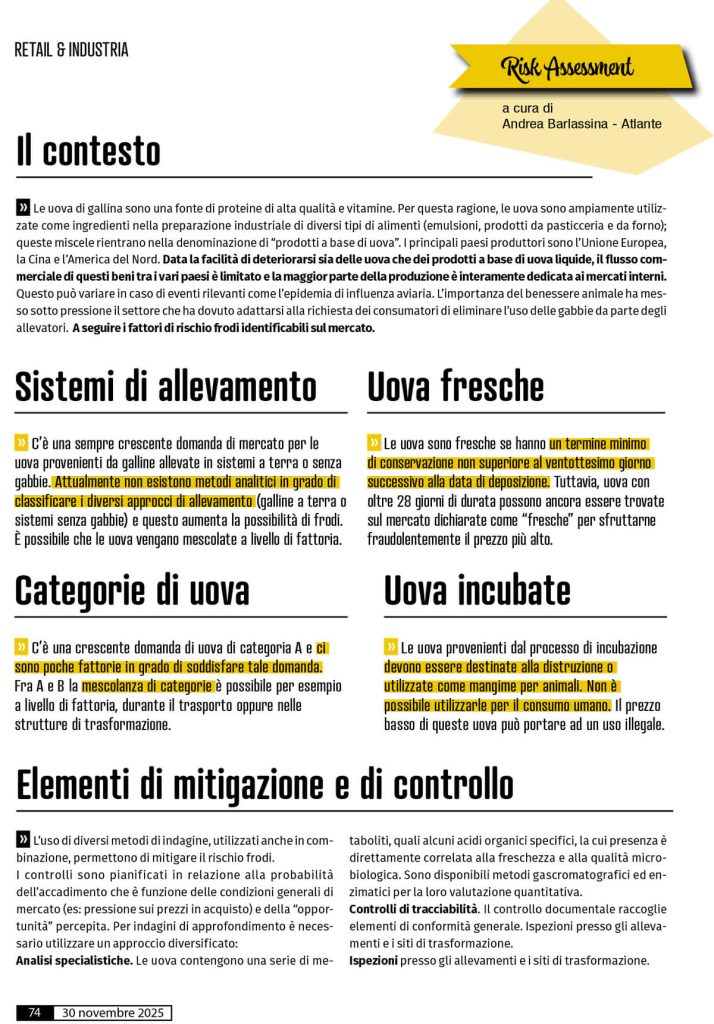
Chicken eggs are a high-quality source of proteins and vitamins. For this reason, eggs are widely used as ingredients in the industrial preparation of various food types (emulsions, pastries, and bakery products); these mixtures fall under the designation of “egg products.” The main producing regions are the European Union, China, and North America. Given the highly perishable nature of both whole eggs and liquid egg products, the international trade flow of these goods is limited, and most production is dedicated entirely to domestic markets. This can change in the event of significant disruptions, such as avian influenza outbreaks. Furthermore, the importance of animal welfare has placed pressure on the sector, which has had to adapt to consumer demands for the elimination of caged farming systems.
The following sections outline the identifiable fraud risk factors in the market.
Farming Systems
There is an ever-growing market demand for eggs from hens raised in barn or cage-free systems. Currently, there are no analytical methods capable of classifying different farming approaches (barn-raised vs. cage-free systems), which increases the potential for fraud. It is possible for eggs from different systems to be mixed at the farm level.
Fresh Eggs
Eggs are considered fresh if they have a minimum shelf life not exceeding 28 days from the date of laying. However, eggs older than 28 days can still be found on the market labeled as “fresh” to fraudulently exploit their higher price point.
Egg Categories
There is an increasing demand for Category A eggs, yet few farms are able to satisfy this demand. The mixing of Category A and Category B eggs is possible, for instance, at the farm level, during transport, or within processing facilities.
Incubated Eggs
Eggs originating from the incubation process must be destined for destruction or used as animal feed; they cannot be used for human consumption. The low price of these eggs can lead to illegal use in the food supply chain.
Mitigation and Control Elements
The use of various investigative methods, often in combination, allows for the mitigation of fraud risk.
Controls are planned based on the probability of occurrence, which is a function of general market conditions (e.g., purchasing price pressure) and perceived “opportunity.” For in-depth investigations, a diversified approach is necessary:
- Specialized Analysis: Eggs contain a series of metabolites, such as specific organic acids, whose presence is directly correlated to freshness and microbiological quality. Gas chromatographic and enzymatic methods are available for their quantitative assessment.
- Traceability Controls: Documentary audits gather elements of general compliance. On-site inspections at farms and processing plants.
- Inspections: On-site inspections at farms and processing plants.
Atlante’s fight against food fraud: a commitment rooted in the supply chain
Food fraud is a real, systemic and often underestimated risk. That is why in 2023 Atlante launched its Food Fraud Risk Assessment programme — a structured approach to identifying, analysing and preventing the risks of adulteration and counterfeiting across the supply chain, coordinated by Enrico Santi, Quality Assurance Manager.
From this expertise comes the collaboration with GDO Week: a column produced by Atlante’s Quality team, with in-depth analysis of individual product categories — covering risk factors, detection methods and mitigation strategies.
A concrete contribution to the industry, aimed at retail chains, buyers and all partners who share the same responsibility: ensuring that what reaches the shelf is exactly what it claims to be.