


15 October 2025
Food FraudFood Fraud: Focus on Processed Tomatoes
L’Osservatorio Food Fraud di Atlante pone l’attenzione sui rischi connessi a prodotti e categorie. L’obiettivo? Diffondere consapevolezza e garantire alle imprese di poter lavorare con maggior responsabilità
Context
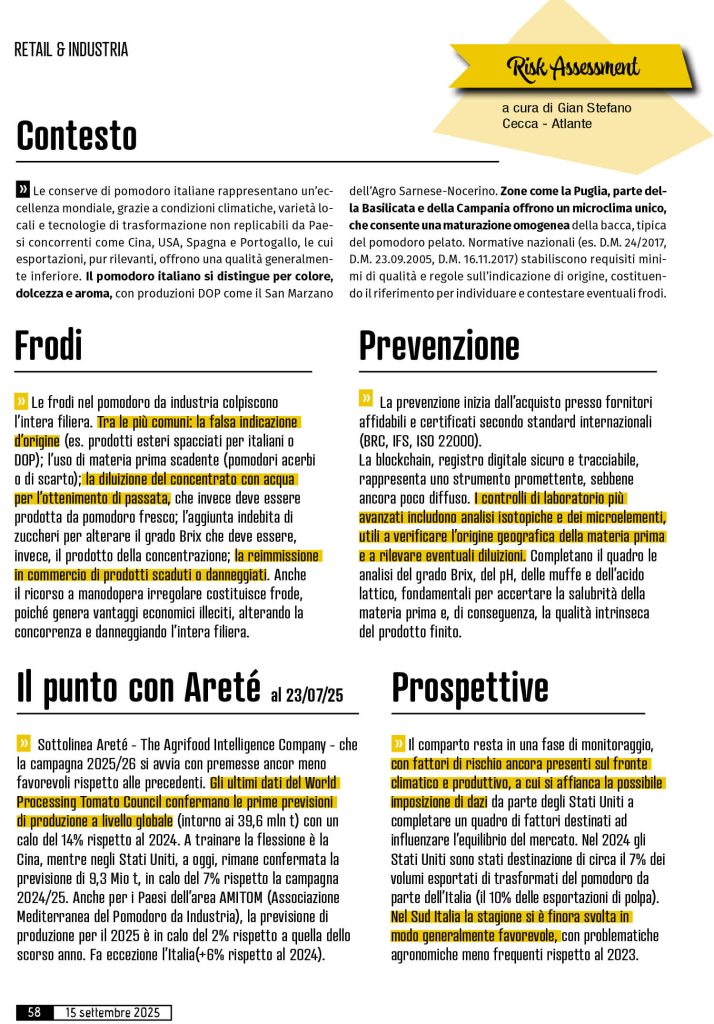
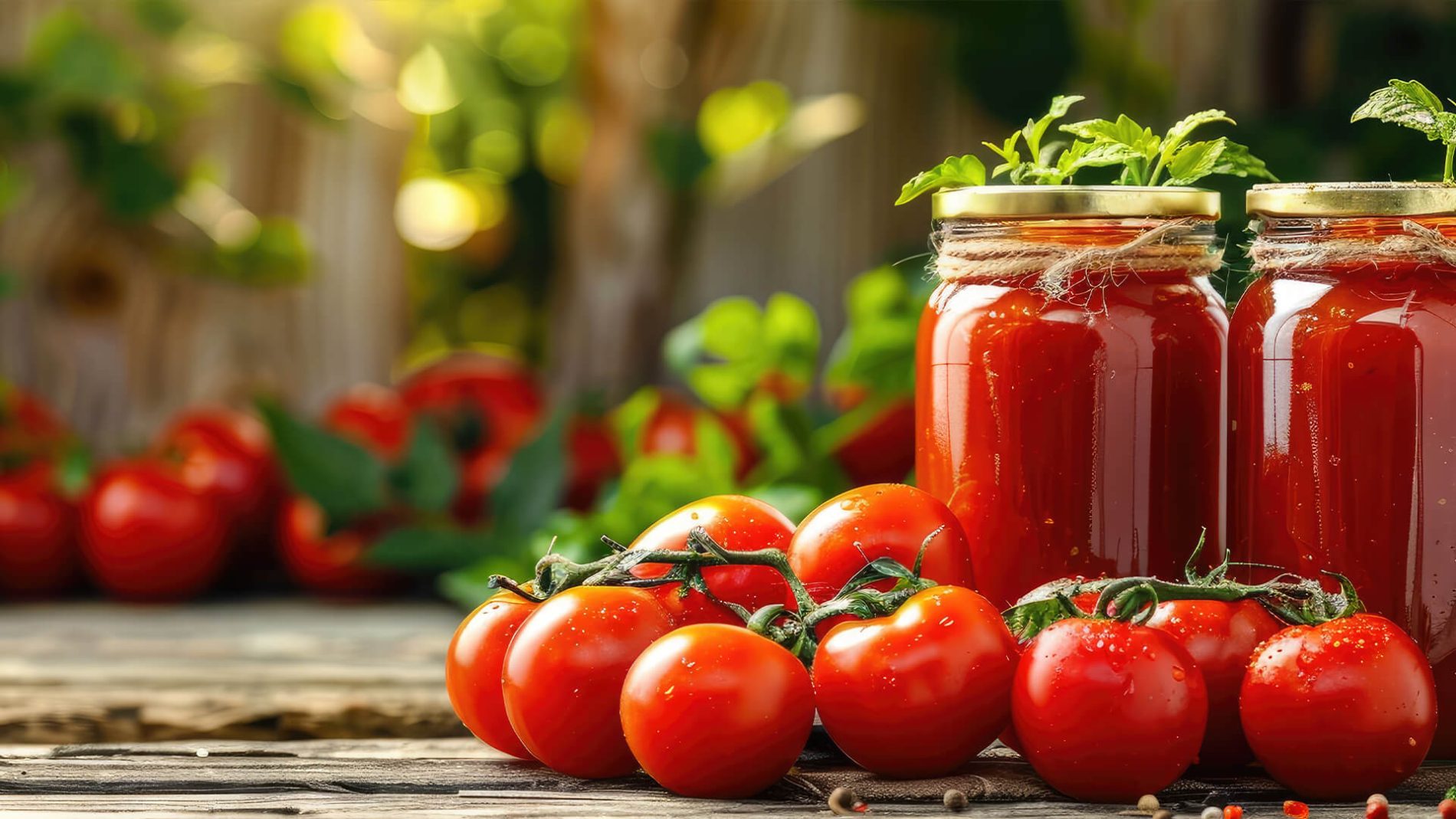
Italian tomato preserves represent a world-class excellence, thanks to climatic conditions, local varieties, and processing technologies that cannot be replicated by competing countries such as China, the USA, Spain, and Portugal, whose exports, while significant, generally offer lower quality. Italian tomatoes are distinguished by their color, sweetness, and aroma, including PDO (Protected Designation of Origin) productions such as the San Marzano from the Agro Sarnese-Nocerino. Regions such as Puglia and parts of Basilicata and Campania offer a unique microclimate that allows for the uniform ripening of the fruit, typical of peeled tomatoes. National regulations (e.g., D.M. 24/2017, D.M. 23.09.2005, D.M. 16.11.2017) establish minimum quality requirements and rules on the indication of origin, serving as the benchmark for identifying and contesting potential fraud.
Fraud
Fraud in the industrial tomato sector affects the entire supply chain. Among the most common types are:
- False indication of origin: for example, foreign products passed off as Italian or PDO.
- Use of substandard raw materials: such as unripe or waste tomatoes.
- Dilution of concentrate with water: to obtain tomato purée (passata), which must instead be produced from fresh tomatoes.
- Undue addition of sugars: to alter the Brix degree, which should instead be the natural result of concentration.
- Reintroduction of expired or damaged products into the market.
The use of irregular labor also constitutes fraud, as it generates illicit economic advantages, distorts competition, and damages the entire supply chain.
Market Update with Areté (as of 07/23/25)
Areté – The Agrifood Intelligence Company – highlights that the 2025/26 campaign is starting with even less favorable premises than previous ones. The latest data from the World Processing Tomato Council confirms initial global production forecasts (around 39.6 million tonnes), a 14% decrease compared to 2024. China is driving this decline, while in the United States, the forecast remains at 9.3 million tonnes, down 7% from the 2024/25 campaign. For countries in the AMITOM (Mediterranean Association of the Industrial Tomato) area, the 2025 production forecast is down 2% compared to last year. Italy is an exception, with a projected increase of 6% compared to 2024.
Prevention
Prevention begins with purchasing from reliable suppliers certified according to international standards (BRC, IFS, ISO 22000). Blockchain, a secure and traceable digital ledger, represents a promising though not yet widespread tool. Advanced laboratory controls include isotopic and microelement analyses, useful for verifying the geographical origin of raw materials and detecting potential dilutions. The framework is completed by analyses of Brix degree, pH, molds, and lactic acid, which are essential to verify the safety of the raw material and the intrinsic quality of the finished product.
Outlook
In Southern Italy, the season has so far proceeded generally favorably, with agronomic issues being less frequent than in 2023.
The sector remains in a monitoring phase, with risk factors still present regarding climate and production.
The possible imposition of tariffs by the United States further influences the market balance. In 2024, the U.S. was the destination for approximately 7% of Italy’s processed tomato export volumes (10% for tomato pulp).
Atlante contro le frodi alimentari: un impegno che parte dalla filiera
La frode alimentare è un rischio reale, sistemico e spesso sottovalutato. Per questo nel 2023 Atlante ha dato vita al programma di Food Fraud Risk Assessment — un percorso strutturato per identificare, analizzare e prevenire i rischi legati all’adulterazione e alla contraffazione lungo tutta la filiera, coordinato da Enrico Santi, Quality Assurance Manager.
Da questa competenza nasce la collaborazione con GDO Week: una rubrica curata dal team Qualità di Atlante, con approfondimenti su singole categorie merceologiche — dai fattori di rischio ai metodi di rilevamento, fino alle strategie di mitigazione.
Un contributo concreto al settore, rivolto alle catene della distribuzione, ai buyer e a tutti i partner che condividono la stessa responsabilità: garantire che ciò che arriva sullo scaffale sia esattamente quello che dichiara di essere.