



10 March 2025
Food FraudFood Fraud: Focus on Biscuits
Atlante’s Food Fraud Observatory focuses on the risks associated with products and categories. The goal? To raise awareness and help businesses operate with greater responsibility.
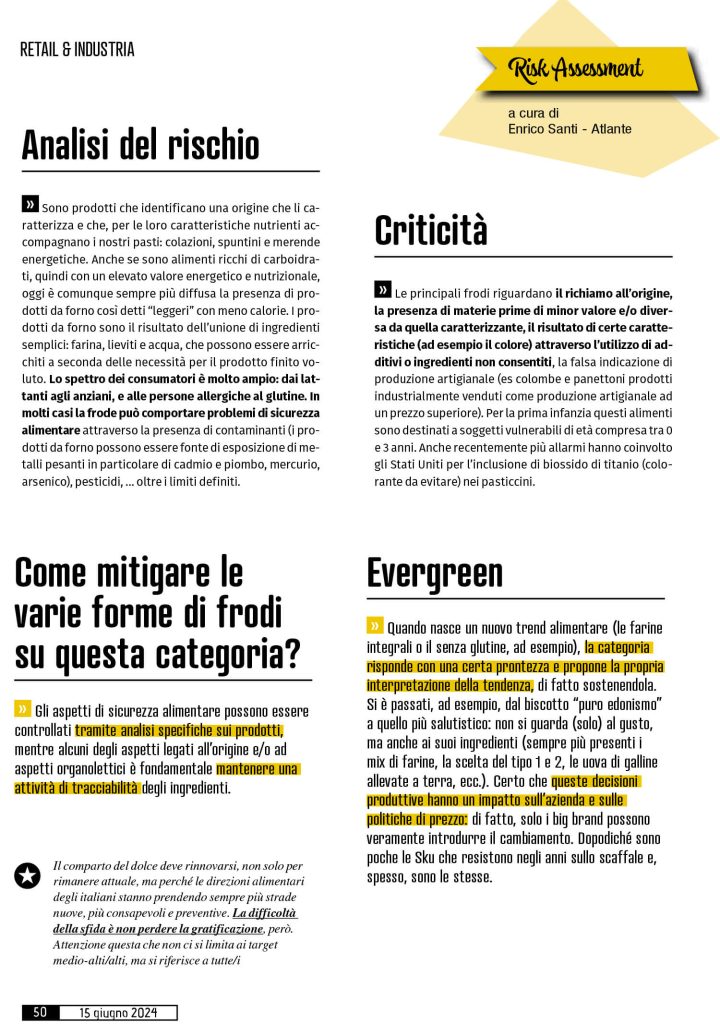
Risk Analysis
Biscuits and baked goods are products with a strong identity, rooted in origin and tradition, consumed throughout the day — from breakfast to snacks. Made from simple ingredients — flour, leavening agents, water — they can be enriched depending on the final product. Their consumption spans a very wide range of people, from infants to the elderly, including those with gluten allergies. This broad reach makes the category one where fraud risk deserves close attention.
In many cases, fraud can lead to food safety issues through the presence of contaminants: baked goods can be a source of exposure to heavy metals — particularly cadmium, lead, mercury and arsenic — as well as pesticides, above permitted limits.
Key Risks
The most common fraud types involve false origin claims, the use of lower-value or non-characteristic raw materials, and the alteration of certain characteristics — such as colour — through the use of unauthorised additives or ingredients. A recurring case is the false indication of artisanal production: industrially produced items such as colomba and panettone are sold as handmade at a higher price. For products intended for early childhood — a vulnerable group aged 0 to 3 — the risk is even more significant. Concerning cases have also been reported internationally: in the United States, multiple alerts were issued regarding the inclusion of titanium dioxide in pastries, a colourant that should be avoided.
Mitigating Fraud in this Category
Food safety aspects can be monitored through specific product analyses. For everything related to origin and organoleptic characteristics, maintaining continuous ingredient traceability is essential.
Evergreen
Every new food trend — from wholegrain flours to gluten-free — finds a quick and coherent response in the biscuit category. The product has evolved from pure indulgence to something increasingly wellness-oriented: not just taste, but attention to ingredients, flour blends and egg sourcing. These production choices have a direct impact on pricing and, in practice, only major brands can introduce them in a structural way. The sweet goods sector must evolve — not to follow a trend, but because Italian eating habits are shifting towards more informed choices. The challenge is to not lose the pleasure along the way.
Atlante’s fight against food fraud: a commitment rooted in the supply chain
Food fraud is a real, systemic and often underestimated risk. That is why in 2023 Atlante launched its Food Fraud Risk Assessment programme — a structured approach to identifying, analysing and preventing the risks of adulteration and counterfeiting across the supply chain, coordinated by Enrico Santi, Quality Assurance Manager.
From this expertise comes the collaboration with GDO Week: a column produced by Atlante’s Quality team, with in-depth analysis of individual product categories — covering risk factors, detection methods and mitigation strategies.
A concrete contribution to the industry, aimed at retail chains, buyers and all partners who share the same responsibility: ensuring that what reaches the shelf is exactly what it claims to be.